.svg)
To Constrain Soaring Health Insurance Premiums, We Must Constrain Growing Health Care Spending
.webp)
Every year, millions of Americans with private insurance receive the unwelcome news that their health insurance premiums are once again increasing. This year will be no different: large employers expect their employee health care costs to increase by 11%, small employers are seeing premium increases of 10 to 20%, and individual insurance issuers are filing double-digit rate increases. This year’s premium increases are among the largest in two decades and follow a trend: health care inflation that outpaces inflation in the broader economy. Today, the Health Care Affordability Lab at Yale is publishing a data visualization and new peer-reviewed research that decomposes what is driving up insurance premiums.
Health insurance premiums have become a major burden across the board; nearly half of people who buy coverage directly and roughly 40% of those with employer plans report struggling to afford their premiums. And the economic strain is felt beyond a family’s bank account. Because employer-sponsored coverage ties health care spending directly to the broader labor market, rising premiums quietly erode wages and cost jobs for workers outside the health sector. What looks like a health care problem is, in reality, a drag on the whole economy.
In a new study published in JAMA Health Forum, we analyzed premiums, health care spending, and insurer markups from 2011 to 2024 across fully insured large-group, small-group, and individual (Marketplace) insurance markets. The picture that emerges is clear, and it should inform how policymakers think about making health insurance more affordable.
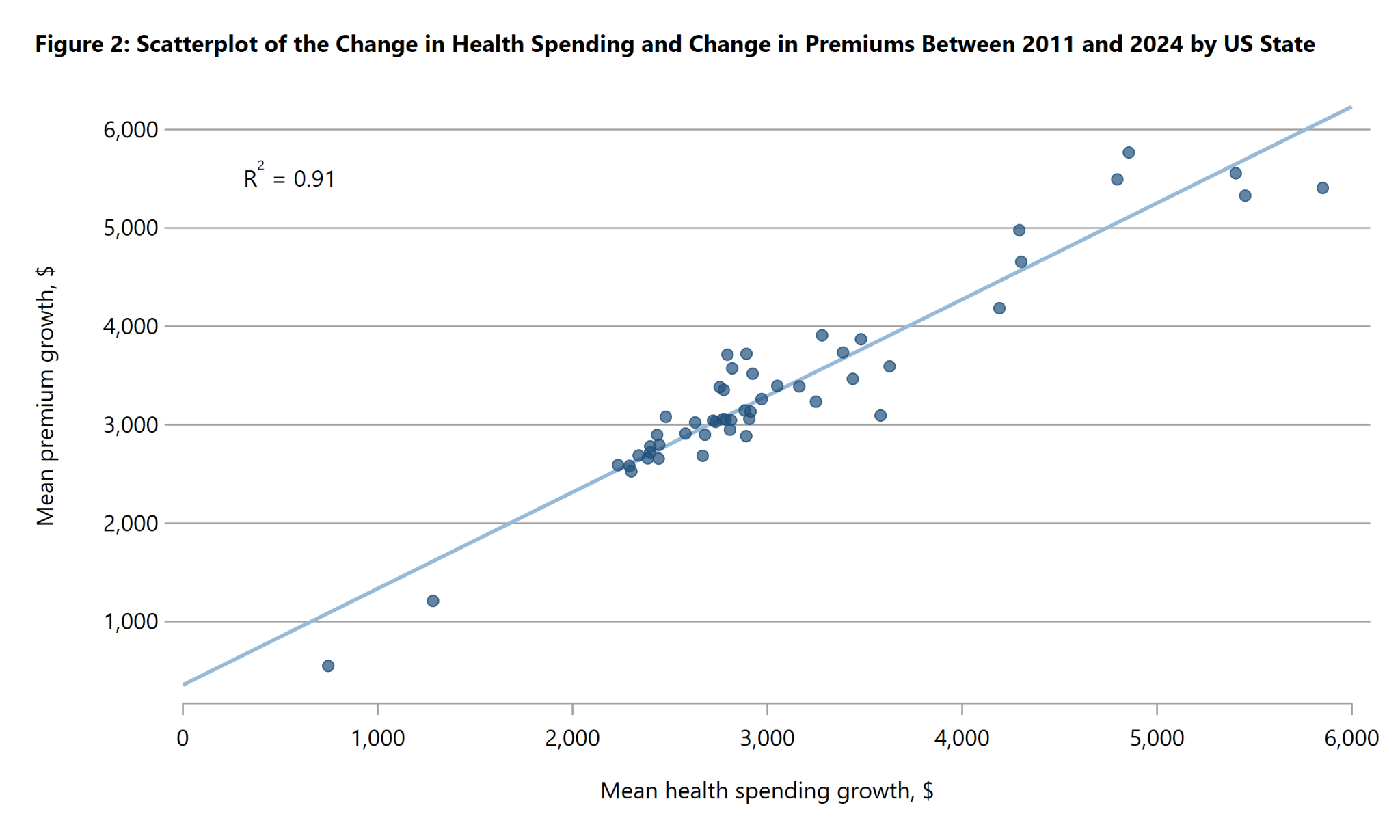
Health spending growth drives premium growth. From 2011 to 2024, average premiums grew by $3,143 per person — a 78% increase. Over the same period, the amount insurers spent on their enrollees' health care grew by $2,844 — an 84% increase. In other words, the growth in health care spending accounts for 91% of the growth in premiums, and health spending grew more rapidly than premiums. In fact, insurers' markups (profits plus administrative costs) shrank as a share of premiums over this period, falling from 18.6% in 2011 to 14.9% in 2024.
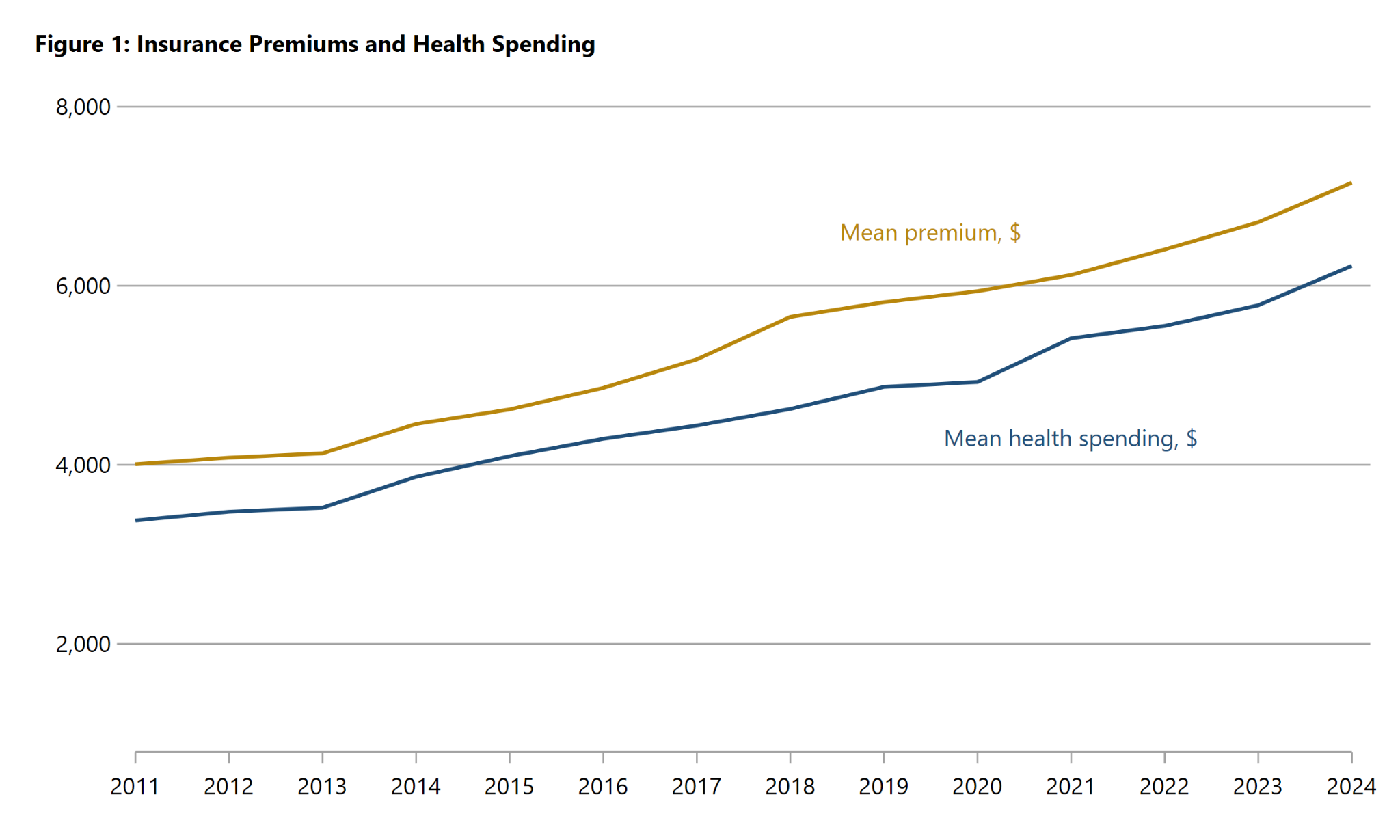
Insurance premiums and markups vary across states, but health spending accounts for the vast majority of premium growth in every state. The states where health spending grew the fastest are, almost without exception, the states where premiums grew the fastest. While premiums varied by a factor of two across states, markups averaged 12.8% of premiums and varied widely by state from a median of $90 in Arkansas to $1,678 in Alaska.
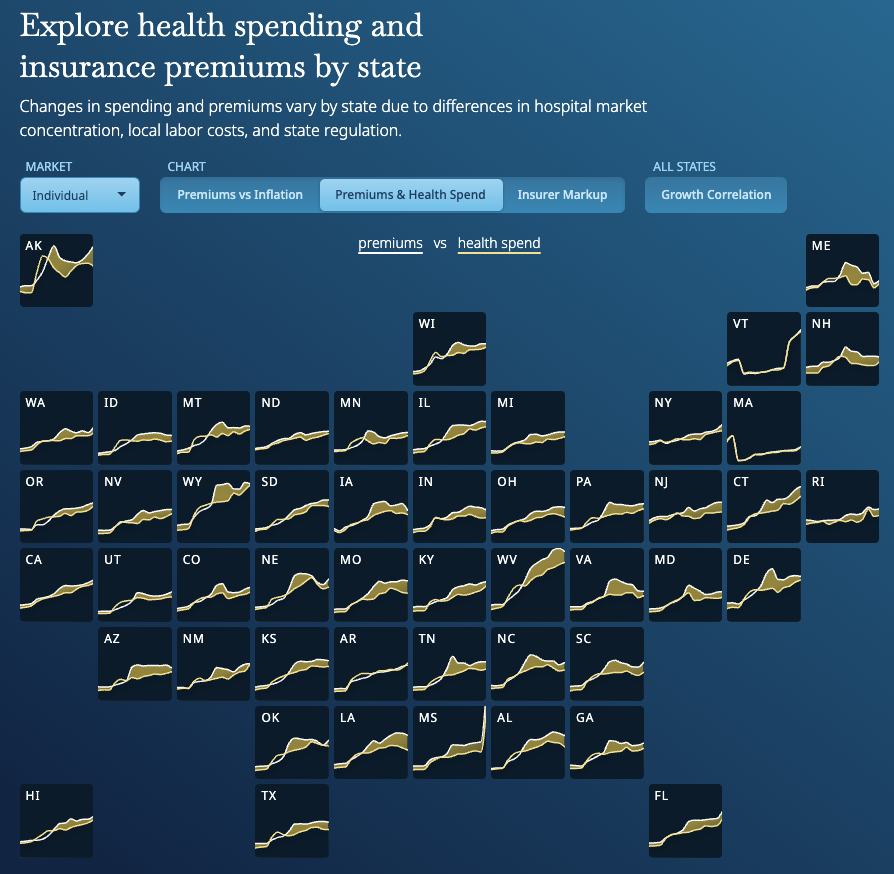
A tool to see it for yourself. Alongside the study, we are releasing an interactive data visualization that lets anyone explore the relationship between premiums and health spending in each state for each private insurance market segment. The tool also lets users track changes in insurer markups by state. Like all of the Lab's tools, it is built on a dataset we have made available for download.
Insurer markups are far from trivial. Efforts to reduce administrative costs and encourage competition in insurance markets have the potential to result in savings for consumers and taxpayers alike. But the data are unambiguous about where the growth is coming from: premiums are rising because the underlying cost of care is rising.
The path to more affordable premiums runs through the cost of care. Until policymakers address underlying health care costs, families will continue to open their annual enrollment packets to the same bad news.
Read the full study in JAMA Health Forum (doi:10.1001/jamahealthforum.2026.3005), and explore the data in our new interactive tool.

.webp)
.webp)
More Commentary

Response to Senate Finance RFI on Lowering Drug Prices for Patients
Where America's Hospitals Are Closing — and Opening