Six Proposed Hospital Mergers–And How They Would Affect Hospital Concentration in Their Communities

Low angle view of people walking in the hallway of a busy hospital.

A new tool from the Health Care Affordability Lab at Yale allows users to explore how hospital mergers, closures, ownership changes, and rising market concentration are reshaping U.S. hospital markets and potentially driving up prices. State and local policymakers may find this tool especially useful as they look for ways to bring down health care costs or prevent further increases. 

>> Explore the interactive <<

The tool’s Forecast Lab feature allows users to simulate hospital ownership changes and forecast the impact of those changes on a hospital market’s concentration, as measured by the Herfindahl–Hirschman Index (HHI)—a standard antitrust metric used to measure market concentration. HHIs range from 0 (many small competitors, unconcentrated) to 10,000 (a monopoly). Mergers that produce a post-merger HHI above 1,800 via an increase of more than 100 points are considered Red Zone Mergers and, according to the Department of Justice and Federal Trade Commission guidelines, are likely to raise prices by lessening competition. 

Not all mergers or transactions are problematic. Our researchers used the Forecast Lab feature of the tool to analyze the impact of several proposed mergers—from Indiana to Washington state to West Virginia. They found that two proposed mergers would increase market concentration in one or more hospital markets, one would decrease concentration, and three would not impact concentration. 

These analyses are based on calculations made with the best available data, which we verify using press releases, news stories, and hospital systems’ financial reporting documents. However, the data may be incomplete, particularly regarding changes to hospital ownership that occurred after 2023, a period for which we rely exclusively on these verification methods. 

In order to measure concentration, we define markets based on a 30-minute travel time. This definition reflects our best effort to approximate a reasonable choice set for patients and does not necessarily represent the relevant market for antitrust enforcement. 


# Proposed Mergers Impact Key result
1 WVU Medicine to acquire Independence Health Red Zone Merger Increases HHI in 3 PA markets; largest increase +2,872 at Penn Highlands Connellsville
2 OhioHealth to acquire Fairfield Medical Ripple Effect No change for merger parties; Diley Ridge Medical Center HHI increases by 408
3 Prime Healthcare to acquire Franciscan Health Olympia Fields Decreases Concentration HHI decreases for 12 hospitals in IL and IN; target hospital drops −157 to 1,661
4 MultiCare to acquire Samaritan Health No Impact No effect on any hospital market HHIs
5 UPMC to acquire Trinity Health System No Impact No effect on any hospital market HHIs
6 Parkview Health to acquire Goshen Health No Impact No effect on any hospital market HHIs

Proposed Mergers That Would Increase Concentration

WVU Health System (Morgantown, WV) acquiring Independence Health System (Greensburg, PA). 

West Virginia-based WVU Health System1 is seeking to acquire Pennsylvania-based Independence Health System’s five hospitals. The transaction is expected to close in fall 2026. 

Acquirer
Hospital System
West Virginia University Health System
System ID #0119
21
Hospitals
2,889
GSAC Beds
7,693
Avg. Hospital HHI
System Hospitals
Hospital Distribution by HHI
1 2 3 4 5 6 7 8 500 1.4K 2.2K 3.0K 3.8K 4.6K 5.4K 6.2K 7.0K 7.8K 8.6K 10K
Target
Hospital System
Independence Health System
System ID #0422
5
Hospitals
755
GSAC Beds
5,331
Avg. Hospital HHI
System Hospitals
Hospital Distribution by HHI
1 2 3 4 5 6 7 8 500 1.4K 2.2K 3.0K 3.8K 4.6K 5.4K 6.2K 7.0K 7.8K 8.6K 10K
Low <1,000
Moderate 1,000 to <1,800
High 1,800 to <5,000
Higher 5,000 to <10,000
Monopoly 10,000
1. The hospital count reflected in the Hospital Markets Data Visualization tool may differ from the count used by a health system due to: (1) a data lag or (2) use of different hospital definitions. This tool includes only general, short-term, acute-care hospitals. It excludes specialty hospitals (psychiatric, rehabilitation, children's, long-term care, VA, or military), urgent-care centers, and facilities without staffed inpatient beds, based on Centers for Medicare & Medicaid Services (CMS) and state licensing data. We identified and verified hospitals using data from CMS, the American Hospital Directory, the American Community Assessment (ACA), and the Lab's own data collection and validation process, which involved scraping and reconciling state licensing records, system websites, and public filings.

Forecasted Impact: This is a RED ZONE MERGER, and it would increase the HHI of three hospitals in Pennsylvania, all in markets with “high” (1,800 to <5,000 HHI) or “higher” (5,000 to <10,000 HHI) concentration. 
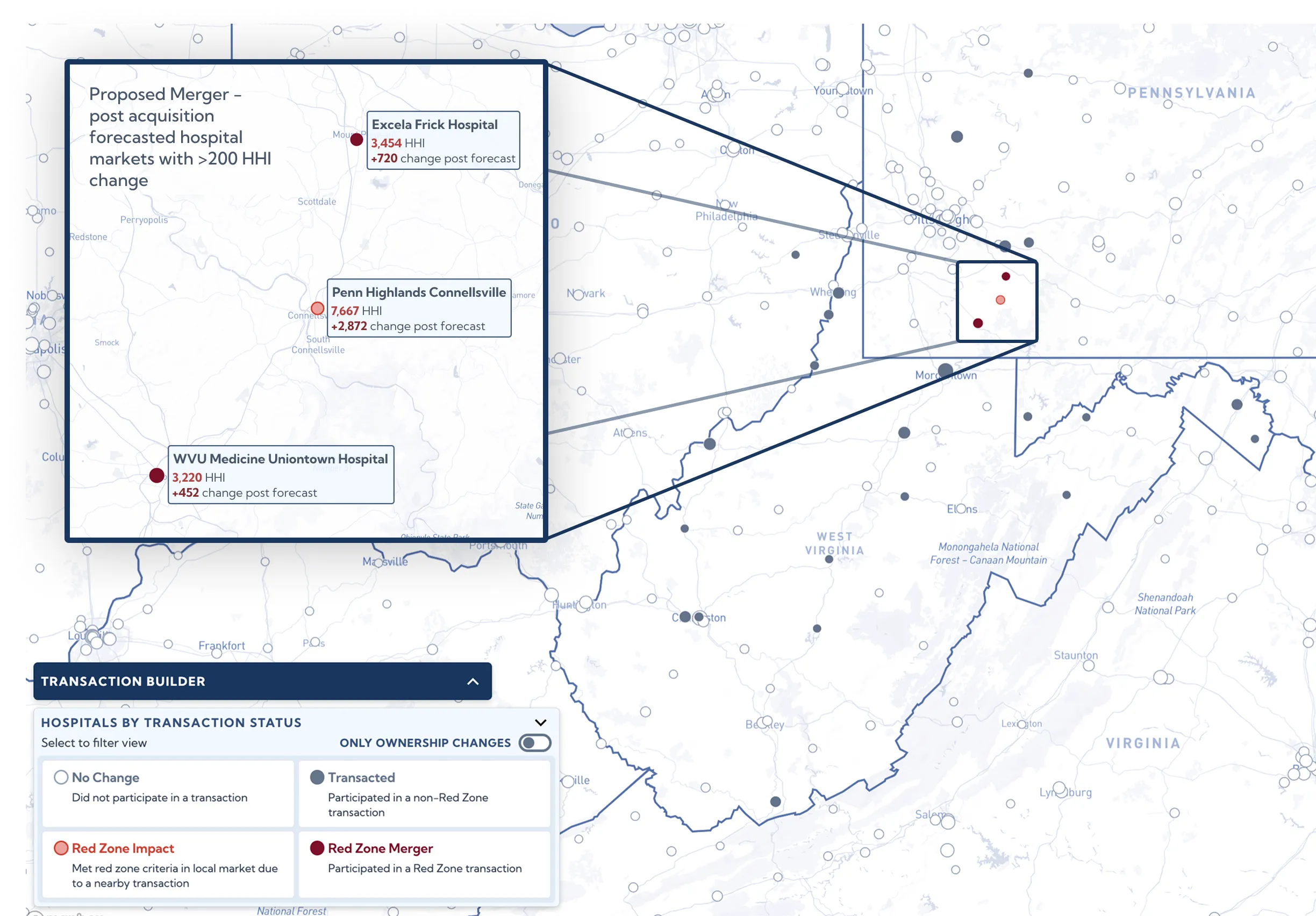
Proposed Merger Forecast Map
Forecast map showing proposed WVU and Independence Health System merger impact on hospital markets, with callouts for Excela Frick Hospital, Penn Highlands Connellsville, and WVU Medicine Uniontown Hospital
This merger would increase concentration in three Pennsylvania hospital markets, including one facility not affiliated with either system.
Classification Red Zone Merger
Combined System Size 30 hospitals
Markets with Increased Concentration 3 (2 merging + 1 nearby)
Largest HHI Increase +2,872 (Penn Highlands Connellsville)

Key Facts:

  • This merger would increase Excela Frick Hospital’s (Mount Pleasant, PA) HHI by 720, resulting in a post-merger HHI of 3,454, further increasing concentration in an already “high” concentration market. 
  • This merger would give WVU two additional hospitals in “high” concentration markets (1,800 to <5,000 HHI) and three additional hospitals in “higher” concentration markets (5,000 to <10,000). According to our dataset, WVU has eight hospitals in monopoly markets, 10 hospitals in “higher” concentration markets, and two hospitals in “high” concentration markets. 
  • Outside of the hospitals WVU currently owns and those it is seeking to acquire, the merger would increase concentration in the Penn Highlands Connellsville (Connellsville, PA) market by 2,872 HHI points, resulting in an HHI of 7,667 and moving the market from the “high” to “higher” category. 

OhioHealth (Columbus, OH) acquiring Fairfield Medical Center (Lancaster, OH).

OhioHealth is seeking to acquire Fairfield Medical Center as its 17th hospital. OhioHealth has acquired 5 hospitals since 2018 and, according to our dataset, operates hospitals in two monopoly markets, six in “higher” concentration markets, and seven “high” concentration markets.

Acquirer
Hospital System
OhioHealth
System ID #0162
15
Hospitals
2,558
GSAC Beds
5,792
Avg. Hospital HHI
System Hospitals
Hospital Distribution by HHI
1 2 3 4 5 6 500 1.4K 2.2K 3.0K 3.8K 4.6K 5.4K 6.2K 7.0K 7.8K 8.6K 10K
Target
Independent Hospital
Fairfield Medical Center
Hospital ID #6411510 · Lancaster, OH
222
GSAC Beds
7,571
Hospital HHI
Hospital Market
Market Share by Hospital Bed Ownership
3
Hospitals
1
System Owner
2
Independents
hospitals, by bed count, colored by HHI
222 beds (86%)
Low <1,000
Moderate 1,000 to <1,800
High 1,800 to <5,000
Higher 5,000 to <10,000
Monopoly 10,000
The hospital count reflected in the Hospital Markets Data Visualization tool may differ from the count used by a health system due to: (1) a data lag or (2) use of different hospital definitions. See explanation in previous footnote.

Forecasted Impact: This merger would not affect the market concentration of the hospital or health system involved in the merger, but it would increase the HHI of Diley Ridge Medical Center, which is not involved in the transaction. This is ​​because Diley Ridge Medical Center is geographically close to the merging hospitals. 
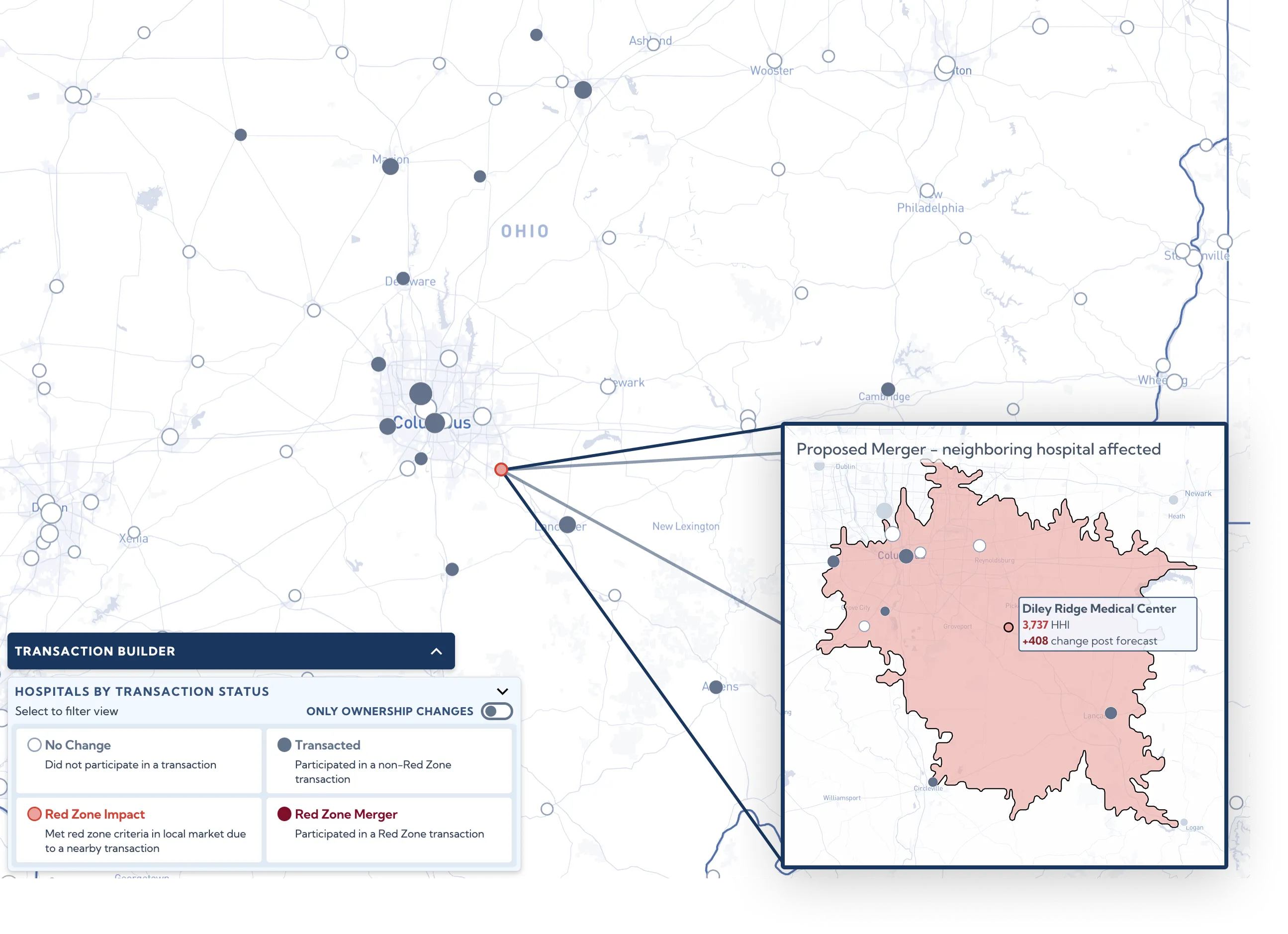
Proposed Merger Forecast Map
Forecast map showing proposed OhioHealth and Fairfield Medical Center merger impact on hospital markets, with callout for Diley Ridge Medical Center
This merger would increase concentration in one hospital market outside the merging systems — the market surrounding Diley Ridge Medical Center.
Classification Ripple Effect
Combined System Size 17 hospitals
Markets with Increased Concentration 1 (outside the merger)
Largest HHI Increase +408 (Diley Ridge Medical Center)
The hospital count reflected in the Hospital Markets Data Visualization tool may differ from the count used by a health system due to: (1) a data lag or (2) use of different hospital definitions. See explanation in previous footnote.

Key Facts:

  • This merger would not affect the market concentration for the hospitals directly involved in the merger.
  • This merger would increase the concentration of the Diley Ridge Medical Center (Canal Winchester, OH) hospital market by 408 to 3,737 because it is geographically close to both sides of the proposed merger.
  • Diley Ridge Medical Center is not affiliated with either health system—it is a nearby facility whose market concentration increases as a ripple effect of the transaction.

Proposed Mergers That Would Reduce Market Concentration

Prime Healthcare (Ontario, CA) acquiring Franciscan Health Olympia Fields (Olympia Fields, IL).

California-based Prime Healthcare (51 hospitals) is seeking to acquire Illinois-based 214-bed Franciscan Health Olympia Fields hospital, currently owned by Franciscan Health, a 13-hospital health system operating in Illinois and Indiana.2

Acquirer
Hospital System
Prime Healthcare Services
System ID #0357
51
Hospitals
8,906
GSAC Beds
3,030
Avg. Hospital HHI
System Hospitals
Hospital Distribution by HHI
1 2 3 4 5 6 7 8 500
Target
Hospital
St James Hosps & Hlth Centers
Franciscan Health Olympia Fields, Illinois
164
GSAC Beds
1,818
Hospital HHI
+150
Beds since 2000
Hospital Market
Market Share by Hospital Bed Ownership
14
Hospitals
6
System Owners
2
Independents
hospitals, by bed count, colored by HHI
Low <1,000
Moderate 1,000 to <1,800
High 1,800 to <5,000
Higher 5,000 to <10,000
Monopoly 10,000
2. In the data visualization tool, Franciscan Health Olympia Fields appears as “St James Hosps & Hlth Centers.” The hospital count reflected in the Hospital Markets Data Visualization tool may differ from the count used by a health system due to: (1) a data lag or (2) use of different hospital definitions. See explanation in previous footnote.

Forecasted Impact: This ownership change would decrease the market concentration of 13 hospitals in Illinois and Indiana, including in Franciscan Health Olympia Fields’ market. A fourteenth hospital not involved in the merger would experience an increase in concentration. 
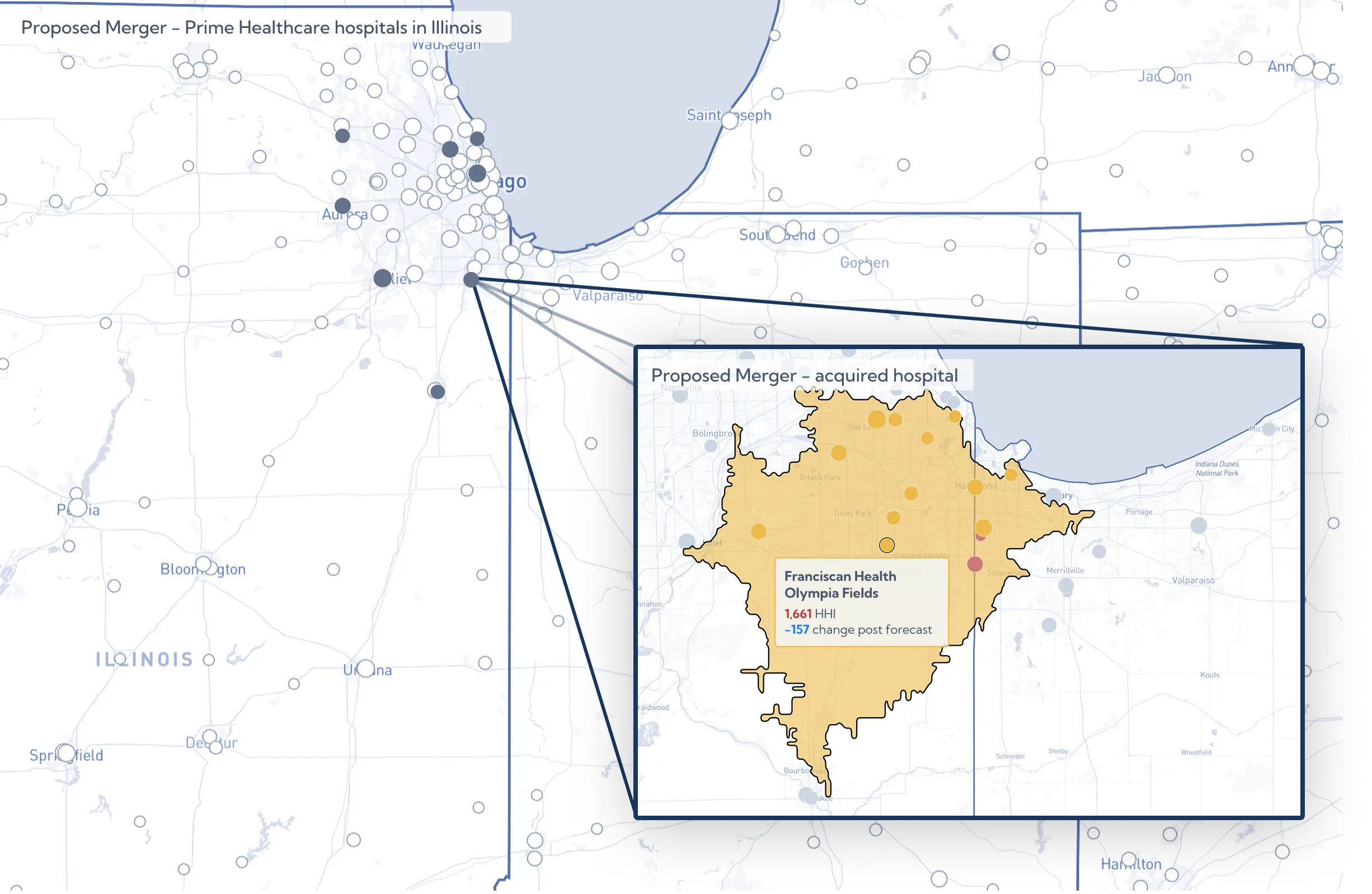
Proposed Merger Forecast Map
Forecast map showing proposed Prime Healthcare and Franciscan Health Olympia Fields merger impact on hospital markets in the Illinois area
This merger would decrease concentration in 13 hospital markets, while slightly increasing concentration near Silver Cross Hospital.
ClassificationDecrease in Concentration
Combined System Size52 hospitals
Markets with Decreased Concentration13 (by 11 to 244 points per market)
Largest HHI Increase+208 Silver Cross Hospital (neighbor)

16 hospitals would be affected by this merger. 13 with decreases to HHI, 1 with an increase of >200, 2 with minor increases.

Hospitals with HHI changes due to proposed merger
Hospital Name In Transaction HHI in 2025 Change from
Proposed
Red Zone
Franciscan Health Olympia FieldsSt James Hosps & Hlth Centers · Olympia Fields, IL Yes 1,661 −157 No
Franciscan Healthcare MunsterMunster, IN · Franciscan Health No 1,959 −244 No
Franciscan Health DyerDyer, IN · Franciscan Health No 1,836 −227 No
Community HospitalMunster, IN · Powers Health No 1,706 −128 No
Franciscan Health HammondHammond, IN · Franciscan Health No 1,461 −115 No
Advocate South Suburban HospitalHazel Crest, IL · Advocate Aurora Health No 1,316 −112 No
St. Catherine HospitalEast Chicago, IN · Powers Health No 1,391 −105 No
UChicago Medicine Ingalls MemorialHarvey, IL · University of Chicago Medicine No 1,136 −95 No
OSF Healthcare Little Company of Mary Medical CenterEvergreen Park, IL · OSF Healthcare No 1,525 −74 No
Roseland Community HospitalChicago, IL · Independent No 1,066 −67 No
Advocate Trinity HospitalChicago, IL · Advocate Aurora Health No 1,152 −63 No
St. Bernard Hospital and Health Care CenterChicago, IL · Religous Hospitallers St Joseph No 746 −33 No
Jackson Park Hospital and Medical CenterChicago, IL · Independent No 718 −11 No
Insight Hospital and Medical CenterChicago, IL · Independent No 632 +1 No
Provident Hospital of Cook CountyChicago, IL · Cook County Health No 666 +1 No
Silver Cross HospitalNew Lenox, IL · Independent No 1,633 +208 No

Key Facts:

  • The merger would decrease the HHI of Franciscan Health Olympia Fields’ (St. James Hospitals & Health Centers in the data visualization tool) hospital market by 157 to 1,661.
  • The merger would decrease the HHIs for 12 other hospitals (by between 11 and 244 points), three of which are owned by Franciscan Health.
  • The merger would newly classify one of the markets for Prime Healthcare’s hospital as highly concentrated. The merger would increase the HHI of Silver Cross Hospital, which is not directly involved in the merger, by 208 to 1,633.

Proposed Mergers That Would Not Impact Market Concentration

MultiCare Health System (Tacoma, WA) acquiring Samaritan Health Services (Corvallis, OR). 

Washington-based MultiCare Health System (13 hospitals) is seeking to acquire Oregon-based Samaritan Health Services (5 hospitals) to create an 18-hospital system. The proposed merger is currently under review by the Oregon Health Authority.3 

Samaritan Health Services presently operates hospitals in five monopoly markets (HHI of 10,000) in Oregon. MultiCare Health System operates hospitals in six “higher” concentrated markets and five “high” concentrated markets in Washington.

Acquirer
Hospital System
MultiCare Health System
System ID #6555
11
Hospitals
2,031
GSAC Beds
4,942
Avg. Hospital HHI
System Hospitals
Hospital Distribution by HHI
1 2 3 4 5 6 7 8 500 1.4K 2.2K 3.0K 3.8K 4.6K 5.4K 6.2K 7.0K 7.8K 8.6K 10K
Target
Hospital System
Samaritan Health Services
System ID #0186
5
Hospitals
308
GSAC Beds
10,000
Avg. Hospital HHI
System Hospitals
Hospital Distribution by HHI
1 2 3 4 5 6 7 8 500 1.4K 2.2K 3.0K 3.8K 4.6K 5.4K 6.2K 7.0K 7.8K 8.6K 10K
Low <1,000
Moderate 1,000 to <1,800
High 1,800 to <5,000
Higher 5,000 to <10,000
Monopoly 10,000
3. The hospital count reflected in the Hospital Markets Data Visualization tool may differ from the count used by a health system due to: (1) a data lag or (2) use of different hospital definitions. This tool includes only general, short-term, acute-care hospitals. It excludes specialty hospitals (psychiatric, rehabilitation, children's, long-term care, VA, or military), urgent-care centers, and facilities without staffed inpatient beds, based on Centers for Medicare & Medicaid Services (CMS) and state licensing data. We identified and verified hospitals using data from CMS, the American Hospital Directory, the American Community Assessment (ACA), and the Lab's own data collection and validation process, which involved scraping and reconciling state licensing records, system websites, and public filings.

Forecasted Impact: This merger would not have any effect on the HHIs of any hospital markets within the two systems, nor on any markets outside the systems.

Proposed Merger Forecast Map
Forecast map showing proposed MultiCare and Samaritan Health Services merger in Washington and Oregon, with callouts for five Samaritan hospitals at 10,000 HHI
This merger would have no measurable impact on hospital market concentration — all five Samaritan hospitals are the sole provider in their markets.
ClassificationNo HHI Impact
Combined System Size16 hospitals
Markets with Increased Concentration0
NoteAll 5 of the Samaritan hospitals are considered monopolies (by our definition)

University of Pittsburgh Medical Center (UPMC) (PA) is acquiring Trinity Health System (OH). 

Pennsylvania-based UPMC (35 hospitals) is seeking to acquire Ohio-based Trinity Health System (3 hospitals). Trinity Health System is owned by Chicago-based CommonSpirit Health, which operates approximately 80 hospitals across the U.S.

Acquirer
Hospital System
UPMC
System ID #0137
35
Hospitals
6,324
GSAC Beds
5,953
Avg. Hospital HHI
System Hospitals
Hospital Distribution by HHI
1 2 3 4 5 6 7 8 500 1.4K 2.2K 3.0K 3.8K 4.6K 5.4K 6.2K 7.0K 7.8K 8.6K 10K
Target
Hospital System
Trinity Health
System ID #1069
3
Hospitals
768
GSAC Beds
10,000
Avg. Hospital HHI
System Hospitals
Hospital Distribution by HHI
1 2 3 4 5 6 7 8 500 1.4K 2.2K 3.0K 3.8K 4.6K 5.4K 6.2K 7.0K 7.8K 8.6K 10K
Low <1,000
Moderate 1,000 to <1,800
High 1,800 to <5,000
Higher 5,000 to <10,000
Monopoly 10,000
The hospital count reflected in the Hospital Markets Data Visualization tool may differ from the count used by a health system due to: (1) a data lag or (2) use of different hospital definitions. This tool includes only general, short-term, acute-care hospitals. It excludes specialty hospitals (psychiatric, rehabilitation, children's, long-term care, VA, or military), urgent-care centers, and facilities without staffed inpatient beds, based on Centers for Medicare & Medicaid Services (CMS) and state licensing data. We identified and verified hospitals using data from CMS, the American Hospital Directory, the American Community Assessment (ACA), and the Lab's own data collection and validation process, which involved scraping and reconciling state licensing records, system websites, and public filings.

Forecasted Impact: This merger would not have any effect on the HHIs of any hospital markets within the two systems, nor on any markets outside the systems. This transaction would add one hospital operating in a market that has a “high” concentration and two hospitals operating in markets with “higher” concentrations to the UPMC health system. 
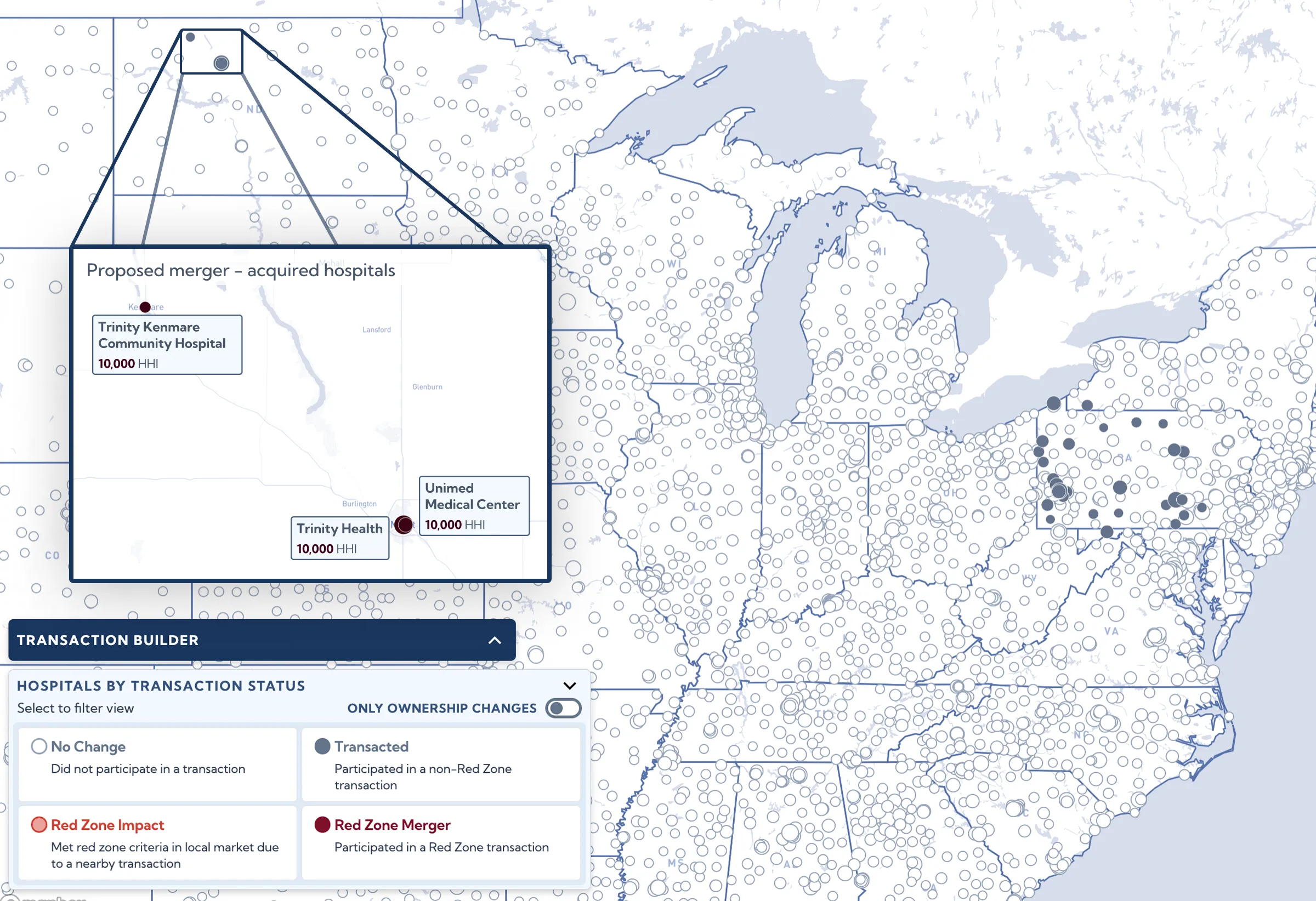
Proposed Merger Forecast Map
Forecast map showing proposed UPMC and Trinity Health System merger across the eastern United States, with callouts for three Trinity hospitals at 10,000 HHI
This merger would have no measurable impact on hospital market concentration — all three Trinity hospitals are the sole provider in their markets.
ClassificationNo HHI Impact
Combined System Size38 hospitals
Markets with Increased Concentration0
NoteAll 3 of the Trinity hospitals are considered monopolies (by our definition)

Parkview Health (Fort Wayne, IN) is acquiring Goshen Health (Goshen, IN). 

Indiana-based Parkview Health4 (14 hospitals) is seeking to acquire Goshen Health, a 105-bed independently owned hospital. Goshen Health currently operates in a “higher” concentration market.

Acquirer
Hospital System
Parkview Health
System ID #0159
8
Hospitals
1,640
GSAC Beds
6,785
Avg. Hospital HHI
System Hospitals
Hospital Distribution by HHI
1 2 3 4 5 6 7 8 500 1.4K 2.2K 3.0K 3.8K 4.6K 5.4K 6.2K 7.0K 7.8K 8.6K 10K
Target
Independent Hospital
Goshen Health
Hospital ID #6420505 · Goshen, Indiana
105
GSAC Beds
5,583
Hospital HHI
−656
Change Since 2000
Hospital Market
Market Share by Hospital Bed Ownership
2
Hospitals
1
System Owner
1
Independent
hospitals, by bed count, colored by HHI
105 beds (33%)
Low <1,000
Moderate 1,000 to <1,800
High 1,800 to <5,000
Higher 5,000 to <10,000
Monopoly 10,000
4. The hospital count reflected in the Hospital Markets Data Visualization tool may differ from the count used by a health system due to: (1) a data lag or (2) use of different hospital definitions. See explanation in previous footnote.

Forecasted Impact: This merger would have no effect on the market concentration of Goshen Hospital or Parkview Health’s hospitals.
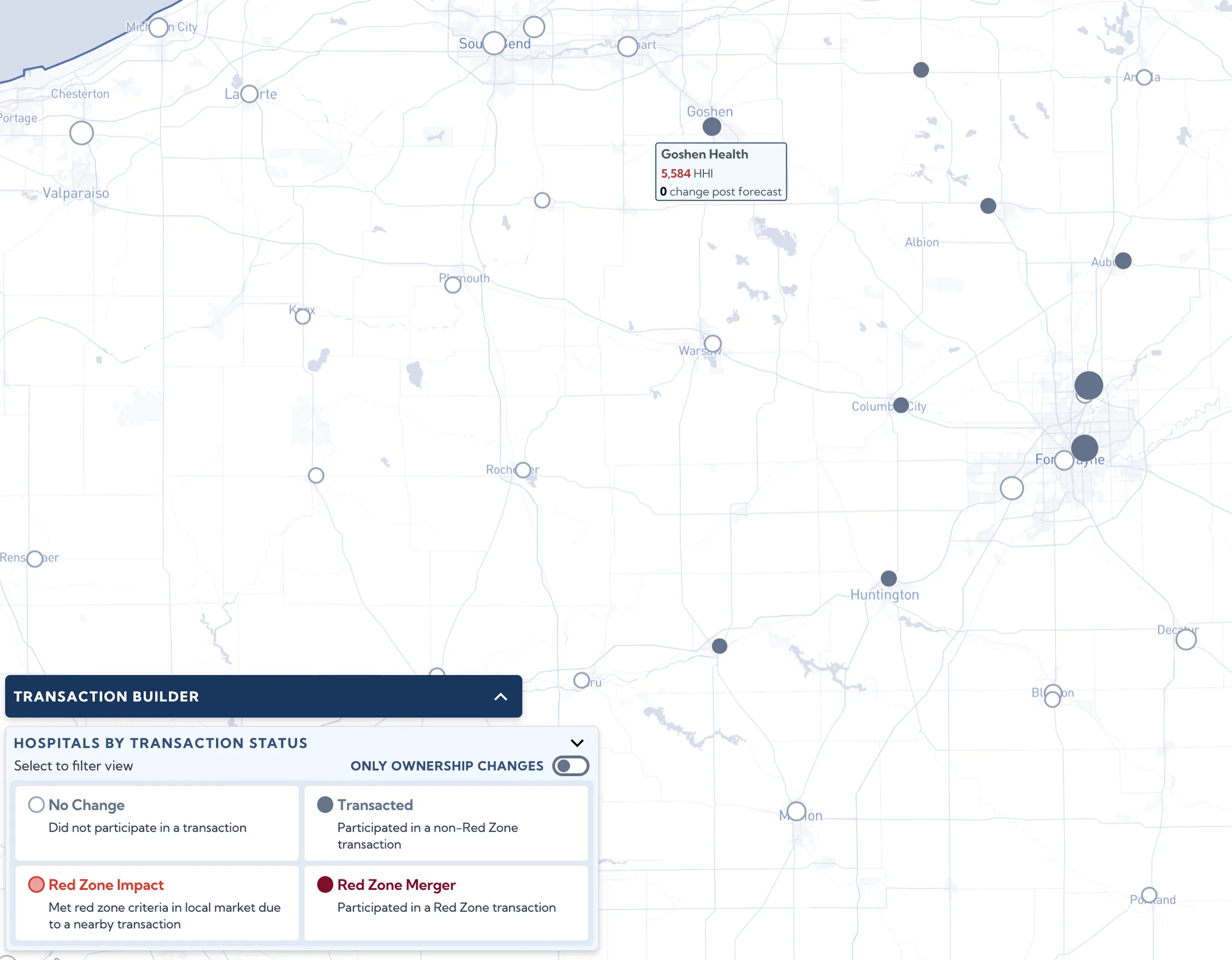
Proposed Merger Forecast Map
Forecast map showing proposed Parkview Health and Goshen Health merger in Indiana, with callout for Goshen Health at 5,584 HHI with no change
This merger would have no measurable impact on hospital market concentration in the Goshen Health service area.
ClassificationNo HHI Impact
Combined System Size9 hospitals
Markets with Increased Concentration0
Largest HHI IncreaseNo changes

More Commentary